eLearning
Strategic Instructional Design

Client
Hexalin Health
Healthcare
Collaborators
Ann-Marie Gregory
eLearning Developer
Time in Design and Development
WIP, 2025
Tools Used
💻 Articulate Storyline
🎬 Vyond
🎨 Figma
📋 Typeform
🗂️ Google Documents
💡 Adobe Illustrator
🖍 Adobe Creative Cloud
🖼️ Canva
📈 Airtable


Project Background and Problem Context
The eLearning project was developed to improve instructional design (ID) model selection for projects allocated to junior instructional designers, using Cathy Moore's Action Mapping framework. The goal, to boost the accuracy of instructional design model rates by 30% by 30th June 2025. The training program included healthcare based training scenarios where the participants evaluated the project elements using the factors in a needs analysis and then choose the most suitable ID model (ADDIE, SAM, Dick & Carey, Merrill's First Principles, Action Mapping), justify their decision and then receive feedback on this decision from senior instructional designers in their team. The program to boost confidence and the decision-making skills of the junior ID's. With a better focus on training design from all instructional designers, course quality would improve and enhance training results, leading to increases in personal and business performance.
Who Is This Course Designed For?
The course is designed for junior instructional designers. The instructional designers have completed studies in instructional design, however they are lacking the ability to practically apply the ID model in a real-world project and are making incorrect decisions. This is affecting business performance and team morale.
What Challenges is the Project Trying to Solve?
Solution Journey
The eLearning program provides junior instructional designers with realistic, scenario-based practice that mirrors the projects they would be given at Hexalin Health. This format gives them the opportunity to analyse the key factors in a needs analysis and how this impacts the instructional design model decision. Through practice, decision making and critical thinking the learner has the opportunity to select the ID model in a safe environment and receive feedback on these choices. By focusing on actionable decision-making and expert feedback, the program bridges the gap between theory and practice, directly improving the accuracy and effectiveness of their ID model choice.
Design and Development
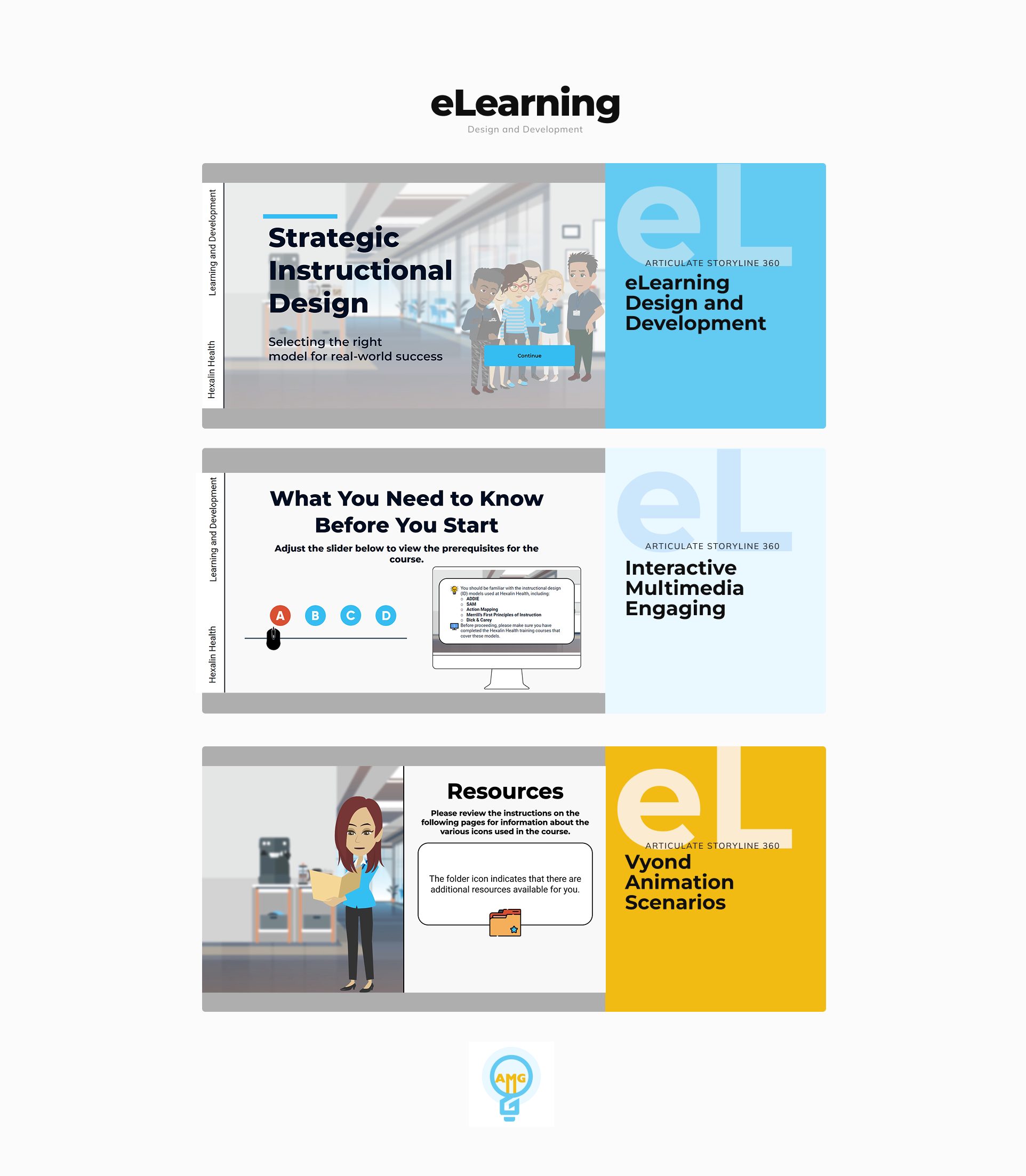
The course was designed using Cathy Moore's Action Mapping framework, focusing on real-world decision, practice scenarios and authentic projects. Take a look at the steps below and how they were a great framework for this project:
Step 1: Identify the Goal
Business Goal:
The goal of this project is to enhance the quality and effectiveness of training programs by ensuring that instructional designers select the most appropriate instructional design model for each course. This will lead to targeted and efficient learning solutions.
Performance Goal:
The accuracy rate of junior instructional designers in selecting the correct instructional design model should increase by 30% by 30th June 2025.
Step 2: Identify What People Need to Do? (What are the Actions?)
The steps the junior instructional designers need to do to achieve this goal:
💡 Analyse project needs from the factors in the needs analysis.
💡 Match the project requirements with the most appropriate ID model.
💡 Justify why they believe that this ID model was the best fit for the project.
💡 Apply feedback from experienced instructional designers to adapt decision if necessary.
Step 3: Design Practice Activities:
I needed to simulate real-world projects and scenarios so that the learner could relate to the project and see how they could apply this in their workplace. To achieve this I designed practice activities and each scenario challenged them to:
👉 Assess the project factors.
👉 Choose an appropriate ID model.
👉 Explain the why behind their choice.
An example of the practice scenarios include:
📝 Data and Privacy Training
📝 Clinical Skills Training
📝 Leadership Development
Step 4: Provide Feedback from Experienced Instructional Designers:
The structure for the feedback mechanisms in the Articulate Storyline course include:
💬 Simulated one-on-one coaching sessions
💬 Group debrief simulation
💬 Written scenario submission and return written feedback from direct manager with what they did right, any improvement suggestions and positive reinforcement and encouragement.
Step 5: What do the Junior Instructional Designers Need to Know?
To support their decision making and improve accuracy of ID model choice, the junior instructional designers need to know:
🙂 The instructional design models used at Hexalin Health, their strengths and weaknesses and the use cases for the models at Hexalin Health. The scenarios do not cover all the ins and outs of instructional design models as this was covered in a previous course that the participants are expected to have completed. It will quickly revise some of the key components.
🙂 The factors affecting ID model choice from the needs analysis: the learner needs to have an understanding of how different variables like timeline and resources impact ID model choice, this information will be covered using multi-media, quick reference guides and interactive comparison charts in Articulate Storyline.
Step 6: Measuring the Progress of the Course:
Tracking course data through learning stats in the LMS and course evaluations will help make adjustments and improvements to the course. This can be measured by:
📈 Obtaining baseline data before the course commences as part of the needs analysis.
📈 Ensuring progress checkpoints are built into the course and regularly reviewed.
📈 An end of financial year assessment to determine if the 30% improvement goal has been achieved.
Challenges and Hurdles
To reduce the risks that were identified as part of the needs analysis , there have been a few preventative measures implemented:
⭐ Low engagement from junior instructional designers: include motivational elements within the course eg ID Model certification or recognition within their peer group and organisation wide.
⭐ Restricted availability of experienced instructional designers: facilitate group feedback sessions if availability is limited, or use intermediate level instructional designers as part of their professional development.
⭐ Slow improvement in ID model selection accuracy: building the complexity of the scenarios as the course progresses and developing additional case studies as a professional development tool after the course completes.
Project Goals
As a result of this course, junior instructional designers demonstrated a significant improvement in their confidence and ability to select the most suitable instructional design model for their courses. The performance goal of 30% improvement in model selection accuracy by 30th June 2025. This improvement will contribute to more targeted, effecient, and learner focused training solutions.
Deliverables
The course consists of 4 lessons, each with interactive components, multimedia and realistic scenarios.
Course Access
Click the link below to have a look at Lesson 1 as an example of the course design in Articulate Storyline.
Vyond Video Example
Click the button to have a look at one of the many Vyond videos used in the course. This mode of multi-media was used to make the scenarios engaging and as realistic as possible. In this example the scene is receiving content via text as a simulation.